English
 Français
 Español
 Deutsch
 Italiano
 العربية




You see how infrared vein visualization changes medical practice by using near-infrared light to target hemoglobin in the blood. This process allows an infrared hospital grade vein finder to instantly display veins beneath the skin, even when you face challenges like variable skin tones or higher body mass. The hospital grade vein finder emits infrared light, which hemoglobin absorbs more than surrounding tissue. This difference creates clear, real-time vein images on the skin’s surface. Recent technology improvements in vein finder devices now combine infrared and ultrasound, making vein visualization more sensitive and accurate. You may support first-attempt venipuncture success and may help reduce unnecessary needle attempts and support patient comfort by choosing a hospital grade vein finder. Vivolight has been dedicated to the medical infrared vein visualization field, providing advanced hospital-grade vein finder solutions with reliable imaging performance for a wide range of clinical settings. When you use an infrared vein finder, infrared projection vein finder, or portable vein finder, you give patients a better medical experience and enhance hospital grade vein finder performance.
Key Takeaways
-
Infrared vein finders use near-infrared light to make veins visible, improving first-attempt success rates for venipuncture.
-
Choosing the right wavelength for vein finders enhances visibility, especially in patients with darker skin or challenging anatomy.
-
Real-time imaging with infrared technology reduces procedure time and increases patient comfort by minimizing the number of needle attempts.
-
Regular maintenance and staff training on vein finder devices ensure optimal performance and consistent results in clinical settings.
-
Integrating vein finder technology into your practice leads to better patient outcomes, and higher satisfaction.
How Infrared Vein Visualization Works
Near-Infrared Light and Hemoglobin
You experience the power of vein detection when you use nir technology in clinical practice. Near infrared light interacts with hemoglobin at the molecular level, making veins visible beneath the skin. This process forms the foundation of modern infrared imaging. You rely on nir to access deeper tissue layers without causing damage. The longer wavelengths of nir penetrate the skin with minimal heat, allowing you to see veins that would otherwise remain hidden.
-
Near infrared light reaches deeper tissue levels, supporting vein detection in patients with challenging anatomy.
-
Hemoglobin absorbs nir, converting it into a high-definition vein image projected onto the skin.
-
Nir wavelengths, longer than visible light, penetrate the skin efficiently and safely.
Infrared imaging takes advantage of the unique absorption properties of hemoglobin. When you use an infrared vein finder, you see veins as dark lines because hemoglobin absorbs the nir, while surrounding tissue reflects it. This difference in absorption and reflection enables vein detection even in patients with variable skin tones or higher body mass. You can visualize veins up to 10 to 15 mm deep using nir technology, which is essential for successful venipuncture.
Source: Igarashi T, et al. "Near-infrared imaging for visualization of superficial veins." Journal of Biomedical Optics.
Nir technology also supports vein imaging in real time. Devices like infrared projection vein finder and portable vein finder use NIR LEDs to map sub-surface veins. You benefit from the ability to locate veins quickly and accurately, improving patient outcomes and reducing procedure time.
Real-Time Vein Imaging
You gain a clear advantage with real-time vein imaging. Infrared imaging allows you to see veins instantly, enhancing your ability to perform venipuncture and other procedures. Nir technology provides a real-time image realism that manual methods cannot match. You observe veins and blood patterns at depths of about 10 mm, which is especially helpful for patients with difficult venous access.
-
Nir light is absorbed by hemoglobin, while surrounding tissue reflects it, making veins stand out.
-
Infrared imaging reveals veins as dark lines on an IR-sensitive camera, supporting accurate vein detection.
-
Devices like infrared vein finder and portable vein finder demonstrate their utility in clinical settings by mapping veins quickly.
You compare vein imaging devices to traditional manual methods by reviewing clinical trial data. The table below shows first-attempt success rates for vein imaging devices versus standard techniques:
|
Study |
Method |
First-Attempt Success Rate |
Statistical Significance |
|---|---|---|---|
|
Perry et al (2011) |
VeinViewer vs Standard |
72.1% (Device) vs 79.0% (Standard) |
Not significant (p > 0.05) |
|
Kim et al (2012) |
VeinViewer vs Control |
69.4% (Device) vs 66.7% (Control) |
Not significant (p > 0.05) |
|
Kaddoum et al (2012) |
AccuVein AV300 vs Standard |
75% (Device) vs 73% (Standard) |
Not significant (p = 0.85) |
|
de Graaff et al (2014) |
VascuLuminator vs Control |
59% (Device) vs 54% (Control) |
Not significant (p = 0.41) |
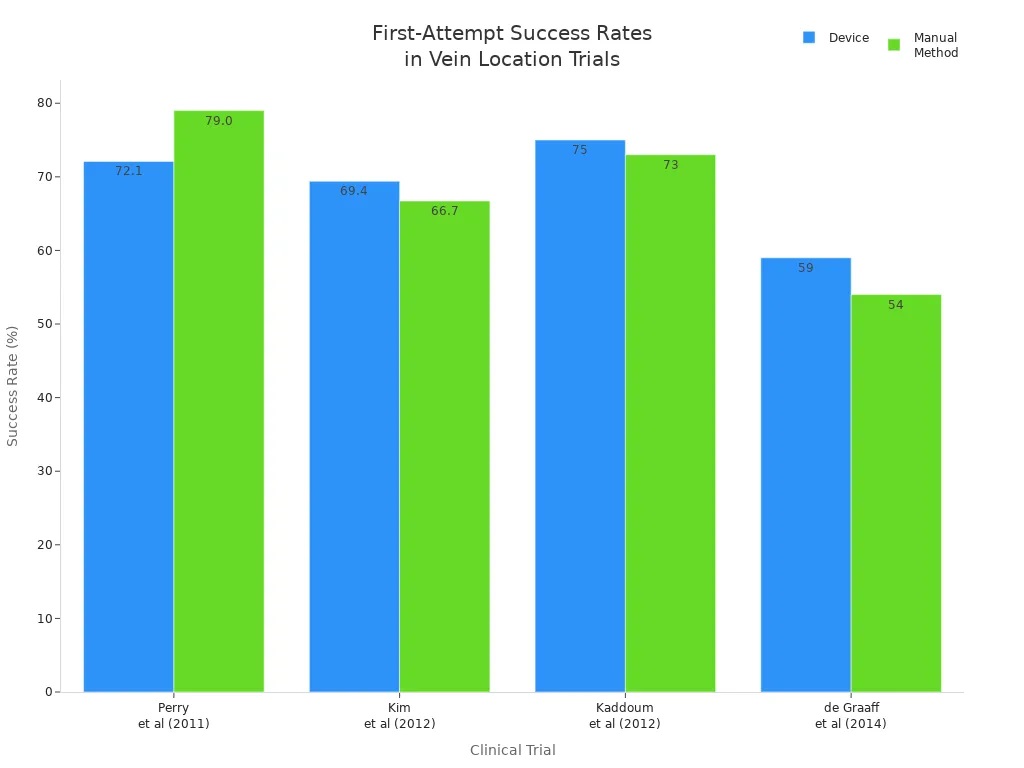
You see that vein imaging devices using nir technology offer comparable success rates to manual methods. However, you notice that infrared imaging provides consistent visualization, especially in patients with difficult veins. You improve your clinical practice by using infrared vein finder, infrared projection vein finder, or portable vein finder. These tools enhance vein detection, reduce procedure time, and increase patient comfort.
Note: You achieve the best results by combining real-time vein imaging with proper training and device selection.
Why Infrared Light Enhances Vein Visualization
Absorption and Reflection in Tissue
You can understand the effectiveness of vein detection by exploring how near-infrared light interacts with human tissue. When you use an infrared vein finder, the device emits near-infrared light that penetrates your skin and reaches the underlying veins. This process relies on two main physical phenomena: absorption and scattering.
-
Near-infrared light passes through the skin and soft tissue with minimal absorption, allowing it to reach deeper layers.
-
Scattering dominates over absorption in the 600–1000 nm wavelength range, so the light spreads throughout the tissue and highlights structures beneath the surface.
Source: Jacques SL. Optical properties of biological tissues: a review. Physics in Medicine & Biology, 2013.
-
Hemoglobin, found in your blood, absorbs near-infrared light more than the surrounding tissue. This property makes veins appear darker in the resulting image.
-
Other molecules, such as melanin, myoglobin, and water, also absorb some light, but hemoglobin remains the primary target for vein detection.
-
The absorption of near-infrared light by hemoglobin creates a strong contrast between veins and the surrounding tissue, improving vein visibility.
You benefit from this contrast because veins stand out clearly against the background of your skin. The technology behind infrared projection vein finder and portable vein finder devices takes advantage of these absorption differences. You can locate veins even in patients with darker skin or higher body mass, where traditional methods often fail. The unique absorption peaks of hemoglobin at specific wavelengths make vein detection reliable and repeatable.
Note: The overlap between melanin and hemoglobin absorption can complicate skin optics, but infrared technology minimizes this challenge by targeting wavelengths where hemoglobin absorption dominates.
Optimal Wavelengths for Vein Finder Devices
You achieve the best results in vein detection when you use devices that operate at optimal wavelengths. Commercial vein finder technology focuses on the near-infrared spectrum, where hemoglobin absorption is strongest and tissue penetration is deepest.
For lighter skin, you get the clearest images in the 750–800 nm range. For darker skin, the 800–850 nm range provides better contrast and deeper penetration. Shorter wavelengths, such as 740–765 nm, are absorbed efficiently by hemoglobin, while longer wavelengths, like 770–780 nm, reach deeper veins. This flexibility allows you to adapt vein detection to different patient needs.
The following table shows how different wavelengths impact vein visualization in clinical settings:
|
Wavelength (nm) |
Device/Study |
Impact on Vein Visualization |
|---|---|---|
|
850 |
AccuVein AV500 |
Reduced failed venipuncture attempts by 39,000 cases annually |
|
940 |
VeinViewer Vision2 |
Improved first-attempt venipuncture success rates by up to 31,000 procedures annually |
You see that infrared devices, such as the infrared vein finder, penetrate deeper layers of the skin and provide clearer vein mapping. Hospitals and clinics use this technology widely, especially for pediatric, geriatric, and emergency cases. You can rely on vein finder devices to improve vein visibility and reduce the number of failed attempts during venipuncture.
-
Infrared vein finder devices use well-defined absorption peaks of hemoglobin at 758 nm and 929 nm for oxy- and deoxyhemoglobin.
Source: Prahl SA. Optical Absorption of Hemoglobin. Oregon Medical Laser Center.
-
Devices like the portable vein finder and infrared projection vein finder allow you to adjust the wavelength for optimal performance in different clinical scenarios.
-
The technology ensures consistent vein detection, regardless of patient age, skin tone, or body composition.
Tip: You maximize vein detection accuracy by selecting vein finder technology that matches the patient's skin type and clinical needs.
You enhance patient care and procedural efficiency by understanding how absorption, reflection, and wavelength selection drive the success of vein visualization technology.
Infrared Technology Advantages
You improve vein detection when you use an infrared vein finder. This technology allows you to visualize veins that are not visible or palpable, especially in patients with challenging anatomy. Infrared vein finder devices increase your first-attempt success rates. In randomized controlled trials, you achieve a 42% first-attempt success rate with infrared devices compared to 38% with traditional palpation. While overall success rates and patient pain scores remain similar, you benefit from a reduction in time to successful cannulation. For example, you can reduce the time to place a peripheral intravenous line from 167 seconds with standard methods to 121 seconds with an infrared vein finder.
Source: Randomized clinical trial evaluating near-infrared vein visualization technology for peripheral intravenous access. Nursing and Emergency Medicine Research on Near-Infrared Vein Visualization Devices.
Tip: You can enhance vein detection and minimize complications by integrating vein finder technology into your clinical workflow.
You see that vein finder devices offer a clear advantage in vein detection, especially for patients with difficult venous access. You provide better care and improve outcomes by adopting these advanced tools.
Clinical Benefits of Infrared Vein Visualization
Improved IV Success Rates
You improve clinical outcomes when you use a vein finder in your medical practice. Infrared vein visualization technology increases your first-attempt success rates for IV placement. In clinical settings, you see a clear difference between groups using near-infrared technology and those using traditional methods.
|
Group Using NIR Technology |
Success Rate |
Control Group Success Rate |
|---|---|---|
|
NIR Technology |
68% |
51% |
Source: Kim MJ, Park JM, Rhee N. "The effect of infrared vein visualization technology on peripheral intravenous access." Journal of Clinical Nursing Research.
ou notice that vein finder devices, such as the infrared vein finder, portable vein finder, and infrared projection vein finder, help you locate veins quickly. This accuracy reduces the number of failed attempts. You spend less time searching for a vein, which means you can focus on patient care. Infrared vein finders also minimize vessel trauma and lower the risk of infiltration or extravasation. In your clinical practice, you see that vein finder technology supports better medical outcomes for patients with difficult venous access.
-
You achieve higher accuracy with vein finder devices.
-
You reduce the time needed for IV placement.
-
You increase safety by minimizing complications.
You also find that vein finders can cut failed first-attempt IV placements by over. This benefit is especially important for patients with deep veins or darker skin tones. Fewer failed attempts mean less distress for patients and more efficient use of nursing time.
Patient Comfort and Safety
You enhance patient comfort when you use vein finder technology in clinical procedures. Patients report lower pain intensity during NIR-guided venipuncture. The Visual Analogue Scale shows that patients experience less pain and fewer needle passes. You create a smoother insertion process, which leads to higher satisfaction.
Source: Randomized controlled studies evaluating patient experience during infrared-assisted venipuncture.
-
Patients feel less pain during vein access.
-
You reduce the number of needle insertions.
-
Patients experience less anxiety and discomfort.
You support patient-centered care by choosing vein finder devices in your clinical workflow. Infrared vein finder, portable vein finder, and infrared projection vein finder devices help you deliver safer and more comfortable medical experiences. You see improved clinical outcomes and greater patient trust in your medical team. In clinical settings, you rely on vein finder technology to provide consistent results for patients, regardless of age, skin tone, or body type.
Note: You build a safer and more efficient clinical environment by integrating vein finder technology into your daily medical practice.
Maximizing Hospital Grade Vein Finder Performance
Best Practices for Clinicians
You maximize the effectiveness of a hospital grade vein finder by following proven strategies. High accuracy and imaging clarity help you visualize each vein with confidence. You select devices that meet international medical standards, which ensures safety compliance in every medical procedure. Lightweight and mobile vein finder devices, such as the portable vein finder, allow you to deploy quickly and adapt to different clinical environments. You choose vein finder models that offer stability and longevity, so you rely on consistent performance for years.
Vivolight provides high-precision technology that supports real-time vein mapping. You use the infrared vein finder or the infrared projection vein finder to locate veins in patients with challenging anatomy. These devices enhance efficiency and reduce procedure time. You improve patient outcomes by integrating vein finder solutions into your workflow.
Tip: Position the vein finder perpendicular to the skin for optimal imaging. Adjust the device’s brightness and contrast settings to match the patient’s skin tone and vein depth.
|
Best Practice |
Benefit |
|---|---|
|
Efficient imaging |
Clear visualization of vein |
|
Safety compliance |
Reliable medical procedures |
|
Mobile device selection |
Quick deployment and efficiency |
|
Stable, durable devices |
Long-term reliability |
Maintenance and Training
You maintain peak performance by caring for your vein finder devices. Regular calibration keeps the vein finder’s imaging system precise. You clean the device after each use to prevent contamination and preserve medical safety. Scheduled maintenance extends the life of your vein finder and ensures high-precision technology remains effective.
Staff training plays a key role in maximizing vein visualization. You standardize techniques across your team, which minimizes variability in vein detection. Training improves interpretive clarity, especially during sensitive procedures like pediatric venipuncture. You achieve reliable outcomes by investing in ongoing education for all clinicians.
Vivolight offers training modules that help you master the use of infrared vein finder, infrared projection vein finder, and portable vein finder devices. You build confidence and efficiency in your clinical practice. You deliver consistent results for every patient, regardless of age or skin tone.
Note: Schedule regular device checks and refresher training sessions to maintain high standards in vein visualization.
You see how vein visualization technology transforms clinical practice by using infrared light, which hemoglobin in the blood absorbs while surrounding tissue reflects. This process creates a clear contrast, making each vein visible as a dark line under the skin.
-
Infrared light remains invisible to the naked eye but proves effective in medical applications.
-
Hemoglobin absorbs infrared light, while skin and tissue reflect it, revealing the vein pattern.
Clinical studies show that vein finder devices increase first-attempt success rates and reduce procedure time. You notice improved patient satisfaction and fewer complications when you use a vein finder. Hospitals report that vein finder technology, such as Vivolight, leads to higher efficiency and support clinical workflow.
|
Study Title |
Findings |
|---|---|
|
Efficacy of VeinViewer in pediatric peripheral intravenous access |
Statistically significant increase in first stick success rates in difficult venous access pediatric patients. |
|
VeinViewer-assisted Intravenous Catheter Placement in a Pediatric Emergency Department |
Decreased time of PIV placement. |
You benefit from vein finder solutions that are cost-effective and easy to use. You help patients experience less pain and faster recovery. Consider integrating a vein finder into your clinical workflow to enhance every vein access procedure.
FAQ
What is a vein finder and how does it work?
A vein finder uses near-infrared light to help you see veins under the skin. The device projects an image of the vein pattern onto the surface. You can locate a vein quickly, which makes procedures easier and more accurate.
Can a vein finder help with hard-to-see veins?
Yes. You can use a vein finder to locate veins in patients with dark skin, obesity, or small veins. The device highlights each vein, even when you cannot see or feel it. This technology improves your success rate during venipuncture.
How does an infrared vein finder differ from traditional methods?
An infrared vein finder uses light absorption to map the vein network. You do not need to rely on touch or guesswork. The device gives you a clear view of each vein, which reduces failed attempts and increases patient comfort.
Is a portable vein finder suitable for all ages?
Portable vein visualization devices can be used to support venipuncture in adults, children, and infants. They provide visual assistance by helping healthcare professionals assess subcutaneous veins across a range of skin tones and vessel depths.
What maintenance does a vein finder require?
You should clean the vein finder after each use. Regular calibration keeps the device accurate. Staff training ensures you use the vein finder correctly. Proper care extends the life of your vein finder and maintains clear vein imaging.

 IPv6 network supported